As an Amazon Associate I earn from qualifying purchases. Some links below are affiliate links, which means I may earn a commission at no extra cost to you.
Best Sunscreen for the Chest: Daily SPF Without a Separate Body Routine
I have buttoned a school-event shirt and noticed a pink V on my chest while my face looked fine. The trap is treating chest sunscreen as a pool-day body lotion job, then assuming the weekday face bottle already covered the skin a neckline shows.
A common pattern is a careful face layer before drop-off, then a collarbone that only gets leftover moisturizer. The chest sits in window light, car light, and open collars more than it looks like it should.
If nothing changes, another season becomes the same loop: covering the chest in photos, or wondering why new spots show up on skin you thought stayed indoors.
This guide names how to compare sunscreen for the chest, which textures sit under a weekday shirt, and how to apply it without turning the bathroom into a second body routine.
When did you last put sunscreen on your chest on a Tuesday, not a pool day?
The short answer
The best sunscreen for the chest is a broad spectrum SPF 30 or higher you will spread onto the V-neck, collarbones, and upper chest in a real layer, then let dry before a shirt goes on. You do not need a separate “chest only” brand. You need enough product on the skin a neckline actually shows.
This article is for shopping and routine habits, not diagnosis or treatment. If your chest burns, swells, itches, or changes quickly, pause product testing and ask a licensed professional.
| If the chest problem is… | SPF lane to compare | Be careful with |
|---|---|---|
| A pink V after a short outdoor stretch | Face fluid used lower, plus enough product | Treating leftover face SPF as enough |
| New spots on the décolletage | Daily chest coverage, not vacation-only lotion | Brightening serums stacked on the same week |
| Shirt marks or a greasy collar | Fast-dry fluid or dry-touch texture | Dressing while the layer is still shiny |
| Dry tightness after a body lotion SPF | A hydrating face fluid on the chest | Thick cream plus thick SPF in one pass |
| No time for a second routine | Same weekday bottle, one extra pass down | Buying a new “chest serum” first |
Why the chest gets skipped
Face sunscreen has a home on the sink. Chest sunscreen does not. I notice this most on weekday mornings when the backpacks are already by the door. Face, neck if I remember, then a shirt. The collarbone is left for later, and later does not happen.
The chest is also easy to underestimate. A cardigan, a car commute, or a classroom window can still reach the V of a shirt. Shade from a building is not the same as a finished SPF layer. For forgotten edges in general, see sunscreen for hands and neck. This article is the shopping slice: a texture you will put on the chest without starting a second shelf.
Body lotion SPF can work. It often fails because people use a thin swipe meant for arms, then stop at the collarbone. Face sunscreen can work on the chest too, if you apply a real amount and give it a minute. For the broader face-versus-body question, see body sunscreen vs face sunscreen.
What to read on the label
“Invisible” and “for face” on the front of a bottle do not tell you whether the formula will sit under a cotton neckline.
Useful clues:
- Broad spectrum. UVA and UVB both matter on weekday chest skin, not only on beach days.
- A clear SPF number. SPF 30 or 50 is the usual shopping range. Higher is not a reason to apply less.
- Texture. Fluid, lotion, dry-touch, or a stick for edges. Pick one you will finish on collarbones.
- Dry-down. A fast-set formula is easier under a shirt than a shiny cream that transfers.
- Fragrance. Scent does not equal protection. It can make a chest test harder to live with under fabric.
- Water resistance. Useful if you sweat. Not a reason to skip a later pass if the shirt comes off.
Do not treat “body” on the label as proof the product will cover the chest well. Coverage is about how much you spread, not the word on the bottle.
Best sunscreen shopping lanes for the chest
These are practical shopping lanes, not a medical ranking. Read the current listing and label before you buy.
1. Lightweight face fluid, used one pass lower
If you already finish a weekday face SPF, the simplest chest plan is the same bottle, one extra pass onto the V-neck and collarbones. A verified fluid is La Roche-Posay Anthelios Ultra-Light Fluid SPF 60.
- Best for: people who will not open a second bottle, makeup mornings, shirts that need a faster dry-down
- What to watch: using the last smear from your hands and calling the chest done
- How to use it: a real amount on the upper chest, then wait until the surface looks set
- Shop: Check current price on Amazon
I use that minute to find the water bottles, not to add a chest serum.
2. Clear-feel sunscreen if cream SPF marks the collar
If lotion SPF leaves a shiny ring inside a light shirt, a verified clear-feel reference is Supergoop! Unseen Sunscreen SPF 40.
- Best for: no-makeup days, a smoother slip over dry collarbones, people who hate a white leftover
- What to watch: dressing too soon; a greasy V if you over-apply and then pull on cotton
- Shop: Check current price on Amazon
Shirt transfer is a real reason people skip the chest. If fabric marks are the whole worry, sunscreen that doesn’t stain clothes covers dry-down in more detail.
3. Dry-touch mineral if the chest feels reactive
If chemical fluids sting or feel slick under a neckline, compare a mineral dry-touch option. A verified reference is Neutrogena Sheer Zinc Oxide Dry-Touch Mineral Sunscreen SPF 50.
- Best for: fragrance-aware tests, a more matte-feeling finish, people who want a mineral label
- What to watch: leftover cast on the chest if you under-blend; crumbs if you rub a shirt over wet product
- Shop: Check current price on Amazon
Compare chest sunscreen SPF on Amazon and read recent reviews for white cast, shirt transfer, and dry-down. Do not treat the search phrase as a guarantee.
4. A stick for the edges a shirt still shows
If a lotion bottle makes you skip the chest because your hands are already messy, a verified stick can cover the V and collarbones after the face is done. Supergoop! Glow Stick SPF 50 is a portable comparison.
- Best for: reapplication after pickup, the last inch a neckline still shows, a console or bag
- What to watch: scribbling a thin stripe and stopping; sticks still need overlapping passes
- Shop: Check current price on Amazon
For pocket reapplication habits, see best sunscreen stick for face. Use the stick on the chest the same way: enough passes to look even, then let it set.
5. Comfort underneath so chest SPF can sit
Dry collarbones make even a decent fluid look patchy. If the chest feels tight before SPF, a verified richer cream is CeraVe Moisturizing Cream with Pump. Keep the morning layer thin. A heavy cream plus SPF is a common reason the shirt picks up product.
- Best for: dry-feeling chest skin, night comfort, a pump that is faster than a jar
- What to watch: a thick morning layer that then pills or transfers
- Shop: Check current price on Amazon
If you want a lighter hydrator first, a verified simple serum is The Ordinary Hyaluronic Acid 2% + B5. Use a small amount on damp skin, then wait. A tacky layer plus SPF plus a cotton V is an easy transfer combo.
If leftover cleanser or a filmy morning wash is part of the problem, a verified gentle option is Cetaphil Gentle Skin Cleanser. For oilier skin, CeraVe Foaming Facial Cleanser is a verified comparison. Cleanse the chest only if you already wash it. Do not add a new scrub to “prep” the area.
- Shop Cetaphil: Check current price on Amazon
- Shop CeraVe cleanser: Check current price on Amazon
If dark spots on the chest are the reason you started looking, daily SPF still comes first. Best sunscreen for dark spots covers that shopping lane without turning the chest into a brightening project.
How this fits a short routine
Keep the order boring. Skin first, shirt last.
- Cleanse as usual. Do not add a chest scrub the same week you test SPF.
- A thin moisturizer on the chest only if the skin feels tight. Wait until it looks settled.
- Face sunscreen as usual.
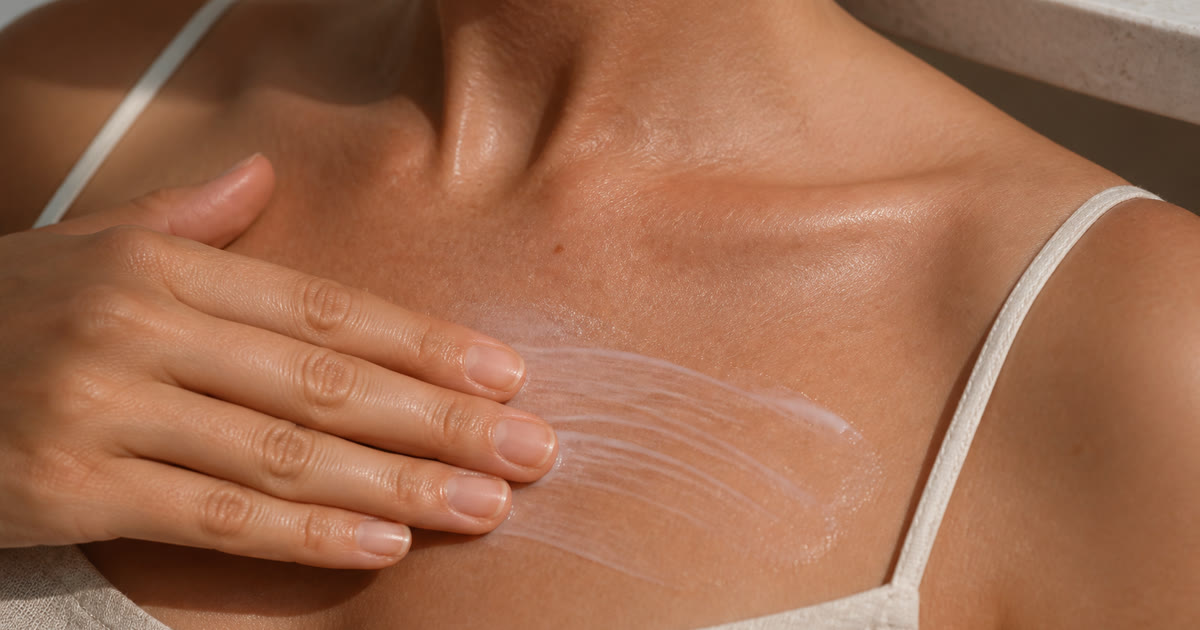
- The same bottle, or a stick, onto the V-neck, collarbones, and upper chest. Use a real amount, not leftover film.
- Wait until the surface looks set.
- Shirt, cardigan, or necklace after the layer is no longer shiny.
- Reapply later if you will be in daylight with an open collar again.
A two-minute weekday still has room for one extra pass if the shelf stays short. See two-minute morning skincare. For how much product counts as a real layer, see how much sunscreen to apply. For how long a layer lasts after it is on, see how often to reapply sunscreen.
How much belongs on the chest
The two-finger rule is a face starting point. The chest still needs enough product to look even on the skin a neckline shows.
A useful weekday method:
- Dispense a nickel-to-quarter size for the upper chest if you are using lotion or fluid.
- Spread from the base of the neck down to the top of the sternum.
- Cover both collarbones and the skin a V-neck or open button still shows.
- Add a second thin pass if the first one disappeared into dry patches.
- Stop before the layer looks like wet body oil.
If you only hit the notch at the base of the throat, the pink V will still show up later. If you coat the whole torso every weekday, you will quit. Cover the skin the shirt does not hide.
Mistakes that leave the chest exposed
- Calling leftover face SPF “chest coverage.” The film on your hands is not a layer.
- Saving body SPF for vacation. Weekday collars still show skin.
- Dressing while the chest is shiny. The shirt lifts product and leaves patchy spots.
- Using less sunscreen so it will not stain. A smear that stays clean can still be a weak layer.
- Adding a brightening chest serum the same week. You will not know whether the SPF, the serum, or the shirt caused the sting.
- Stopping at the neck and hoping gravity helps. Sunscreen does not travel down a shirt.
The smaller change is often enough: the weekday bottle you already tolerate, one extra pass, and a minute before the tee.
A simple testing plan
- Choose one lane: face fluid used lower, clear-feel, dry-touch mineral, or a stick for edges.
- Read the current label for SPF, broad spectrum, and texture.
- Patch test if your skin is cautious, especially on the inner arm or a small chest spot.
- Use it as your only new chest SPF for several weekday mornings.
- Wear a shirt you can inspect. Check the inside collar after pickup.
- Keep night products familiar. Do not add a new retinoid, peel, or chest oil in the same window.
- Continue only if you will still apply a real layer, not a swipe you hope will not mark fabric.
My note is plain: product, shirt neckline, “chest covered,” “pink V,” or “collar mark.” It keeps me from blaming the weather when I skipped the collarbones.
Quick shopping checklist
- Is it broad spectrum with a clear SPF number?
- Will I put it on the chest on a weekday, not only on a pool day?
- Can I apply a real amount to the V-neck and collarbones?
- Does it dry down before a cotton neckline goes on?
- Am I testing one new SPF, not a new chest serum too?
- Will I stop and get professional advice if my skin stings, swells, or changes quickly?
If the answers point to one fluid, mineral, or stick you will finish, you have a reasonable candidate. If the plan needs a new body oil, a new brightening serum, and a new SPF to make sense, keep comparing.
The bottom line
The best sunscreen for the chest is the one you will apply generously to the skin a neckline shows, then let set before the shirt.
Start with one lane: the weekday face fluid used one pass lower, a clear-feel formula, a dry-touch mineral, or a stick for edges. Keep the rest of the shelf familiar while you learn whether the pink V stops showing up.
You do not need a second body routine. You need enough product on the collarbones, and a minute before you dress.
Prices and availability change often - check the current price on Amazon.
As an Amazon Associate I earn from qualifying purchases.